

Shared vs VPS vs Dedicated Hosting – Full Comparison Guide 2026
When it comes to shared vs VPS vs dedicated hosting, picking the wrong option can cost you in performance, security, and money. Whether you are launching your first website or scaling an established business, understanding how these three hosting types compare is one of the most important decisions you will make online. In this full comparison guide, we break down every difference — from price and performance to control and scalability — so you can make a confident, informed choice in 2026.
Furthermore, this guide goes beyond the basics. You will find a side-by-side comparison table, real-world use cases, and a clear verdict for each hosting type. As a result, by the end of this article, you will know exactly where your website belongs.
Why the Shared vs VPS vs Dedicated Hosting Decision Matters
Your hosting environment is the foundation of everything your website does — how fast it loads, how securely it operates, and how well it holds up under traffic. Moreover, the wrong choice doesn’t just affect performance today; it shapes how easily your site can grow tomorrow.
Many website owners start on the wrong plan simply because they did not understand the differences upfront. Consequently, they end up either overpaying for resources they don’t need or — far more commonly — stuck on an underpowered plan that is quietly hurting their rankings and user experience.
Understanding the shared vs VPS vs dedicated hosting comparison means understanding three fundamentally different approaches to how server resources are allocated, managed, and priced. Therefore, let’s start with the foundations.
Quick Overview: Shared, VPS, and Dedicated Hosting Explained
Before diving into the detailed comparison, here is a plain-language summary of how each hosting type works.
What is Shared Hosting?
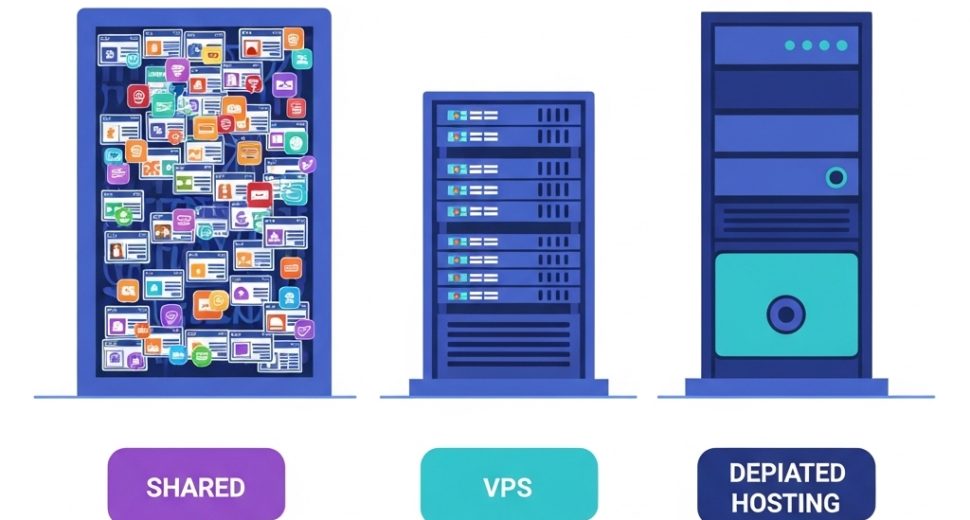
Shared hosting places your website on a server alongside hundreds — sometimes thousands — of other websites. All of these sites draw from the same pool of CPU, RAM, and bandwidth. It is the most affordable option available and requires zero technical knowledge to manage. However, the trade-off is that your site’s performance is influenced by what your neighbors on the server are doing.
What is VPS Hosting?
A Virtual Private Server (VPS) uses virtualization technology to divide one physical server into multiple isolated environments. Each VPS gets its own dedicated slice of CPU, RAM, and storage — guaranteed resources that no one else can consume. Additionally, VPS users typically get root access, meaning full control over the server environment. If you’re unsure whether VPS is right for you, our types of web hosting guide covers all the fundamentals.
What is Dedicated Hosting?
Dedicated hosting gives you an entire physical server exclusively for your website or application. There is no sharing whatsoever — every resource belongs to you. As a result, dedicated hosting delivers the highest possible performance and the most complete control, but it also comes at the highest price point and requires the most technical expertise.
Shared vs VPS vs Dedicated Hosting: Side-by-Side Comparison
The table below summarises the key differences across all three hosting types at a glance. Use it as a quick reference when evaluating your options.
| Feature | Shared Hosting | VPS Hosting | Dedicated Hosting |
|---|---|---|---|
| Price | $2 – $10/mo | $10 – $60/mo | $80 – $300+/mo |
| Performance | Basic | Good – Very Good | Excellent |
| Resources | Shared | Dedicated slice | Fully dedicated |
| Scalability | Low | Medium – High | Low (fixed hardware) |
| Security | Basic | Strong | Maximum |
| Control / Root Access | None | Full (unmanaged) | Full |
| Technical Skill Needed | None | Medium | High |
| Uptime Reliability | Good | Very Good | Excellent |
| Best For | Beginners, small sites | Growing businesses | Enterprises, high-traffic |
Shared Hosting – Best for Beginners and Small Websites
Shared hosting is where most websites begin, and for good reason. It is the most accessible entry point into the web hosting comparison — low cost, easy setup, and no technical knowledge required.
How Shared Hosting Performs in Real Use
For a new blog, a small business brochure site, or a portfolio, shared hosting performs perfectly well. Pages load at acceptable speeds, uptime is generally reliable, and the included tools — cPanel, one-click installers, email accounts — cover everything a beginner needs.
However, performance can degrade noticeably during traffic peaks. Because resources are shared across all accounts on the server, a sudden spike in traffic to one site can slow down every other site on that machine. This is commonly known as the “bad neighbor effect.”
Shared Hosting Security Considerations
Security on shared hosting is handled primarily by the provider. Although most reputable providers include firewalls, malware scanning, and free SSL certificates, the shared environment does create some inherent risk. If one account on the server gets compromised, there is a small but real possibility it could affect neighbouring accounts. Therefore, choosing a reputable provider with strong server-level security is especially important on shared plans.
Who Should Choose Shared Hosting?
- First-time website owners with no technical background
- Bloggers and content creators just getting started
- Small businesses with simple, low-traffic websites
- Developers building and testing new projects on a budget
Shared Hosting Pros and Cons
- ✅ Cheapest hosting option available
- ✅ No server management required
- ✅ Beginner-friendly control panels
- ✅ Most plans include email hosting and free SSL
- ❌ Resources are shared — performance can be inconsistent
- ❌ Limited control over the server environment
- ❌ Not suitable for high-traffic or resource-heavy sites
VPS Hosting – The Best Hosting Type for Growing Businesses
In the shared vs VPS hosting debate, VPS wins on performance, control, and security every time — at the cost of a higher price and slightly more complexity. For businesses that have outgrown shared hosting, a VPS is almost always the right next step.
How VPS Hosting Performs Compared to Shared
Because VPS resources are isolated and guaranteed, performance is dramatically more consistent than shared hosting. Your site gets a fixed allocation of CPU and RAM that no other user can consume. Additionally, most VPS environments use SSD storage and support advanced caching configurations, which translates to noticeably faster load times.
Furthermore, VPS hosting handles traffic spikes far more gracefully. Where a shared server might slow to a crawl when a popular post goes viral, a VPS absorbs that traffic without breaking a sweat — provided the plan is sized appropriately.
Managed vs Unmanaged VPS: Which Should You Choose?
This distinction is critical when comparing VPS vs dedicated server options and evaluating your own technical comfort level:
- Managed VPS — the provider handles all server-level tasks: updates, security patches, monitoring, and backups. You focus entirely on your website. Ideal for business owners who want the power of VPS without the technical overhead.
- Unmanaged VPS — you have full root access and complete control, but you are responsible for everything. Best for developers and system administrators who know their way around a Linux server.
Who Should Choose VPS Hosting?
- E-commerce stores processing regular transactions
- Growing businesses receiving consistent traffic above 20,000 monthly visits
- Web developers who need custom server configurations
- Businesses running multiple websites or web applications
- Anyone whose shared hosting plan is causing slow load times or downtime
VPS Hosting Pros and Cons
- ✅ Dedicated resources — guaranteed CPU and RAM
- ✅ Significantly better performance than shared hosting
- ✅ Full root access on unmanaged plans
- ✅ Scalable — upgrade resources without migrating
- ✅ Stronger security through environment isolation
- ❌ More expensive than shared hosting
- ❌ Requires technical knowledge on unmanaged plans
- ❌ Still shares the physical server with other VPS users
Dedicated Hosting – Maximum Performance for High-Traffic Websites
At the top of the shared vs VPS vs dedicated hosting spectrum sits dedicated hosting — the most powerful, most secure, and most expensive option available. When you choose a dedicated server, you are renting an entire physical machine that belongs exclusively to your website or application.
Dedicated Server Performance and Control
Dedicated hosting eliminates every performance variable that affects shared and VPS environments. There are no neighbours, no resource contention, and no virtualization overhead. Consequently, dedicated servers deliver the fastest possible response times and handle enormous traffic volumes without any degradation.
Additionally, dedicated hosting gives you complete control over the hardware specification — choose your CPU, RAM, storage type and size, and operating system. This level of customisation is simply not possible on shared or VPS plans.
Dedicated Hosting Security Advantages
From a security standpoint, dedicated hosting is in a class of its own. Because you are the sole occupant of the server, there is zero risk of a neighbouring account’s vulnerability affecting yours. Moreover, industries with strict compliance requirements — healthcare, finance, legal — often mandate dedicated infrastructure to meet data protection regulations such as HIPAA or GDPR. According to Cloudflare, dedicated environments provide the highest level of network isolation available in traditional hosting.
Who Should Choose Dedicated Hosting?
- Large enterprises and high-traffic platforms (1M+ monthly visits)
- Businesses with strict data privacy and compliance requirements
- Online stores with high transaction volumes and sensitive customer data
- Gaming servers, streaming platforms, and resource-intensive applications
- Organisations that need full hardware-level customisation
Dedicated Hosting Pros and Cons
- ✅ Unmatched performance — all resources exclusively yours
- ✅ Full hardware and software control
- ✅ Maximum security and isolation
- ✅ Best choice for compliance-sensitive industries
- ❌ Most expensive hosting option by a wide margin
- ❌ Requires advanced technical expertise to manage
- ❌ Less flexible than cloud hosting for sudden scaling needs
Shared vs VPS vs Dedicated Hosting – Performance Deep Dive
Performance is often the deciding factor in the hosting plan comparison. Let’s look at how each option stacks up across the metrics that matter most.
Page Load Speed
Shared hosting typically delivers page load times of 600ms–1200ms under normal conditions. VPS hosting, by contrast, routinely achieves 200ms–500ms response times due to dedicated resources and optimised configurations. Dedicated hosting can push this even further, often achieving sub-200ms server response times for well-optimised sites. According to Google’s Core Web Vitals guidelines, a Time to First Byte (TTFB) under 800ms is considered good — VPS and dedicated hosting make this consistently achievable.
Uptime and Reliability
All three hosting types can achieve 99.9% uptime with a quality provider. However, shared hosting is more susceptible to unexpected downtime caused by other accounts on the server. VPS and dedicated hosting offer more stable, predictable uptime because resources are isolated and not subject to the same external pressures.
Handling Traffic Spikes
Shared hosting struggles significantly with sudden traffic increases. A viral post or a marketing campaign driving thousands of simultaneous visitors can overwhelm a shared server and take your site offline. In contrast, VPS hosting handles moderate spikes gracefully, and dedicated hosting absorbs even very large traffic surges without performance loss.
Cost Comparison: Which Hosting Type Offers the Best Value?
Price is inevitably part of the shared vs VPS vs dedicated hosting conversation. However, the cheapest option is not always the best value — especially when poor performance leads to lost visitors and lower search rankings.
Shared Hosting Cost Breakdown
Shared hosting plans typically range from $2 to $10 per month. Introductory offers can be as low as $1–$2/month, but always verify the renewal rate before committing. For a new website with modest expectations, shared hosting delivers excellent value at this price point.
VPS Hosting Cost Breakdown
VPS plans range from approximately $10 to $60 per month, depending on the resources allocated and whether the plan is managed or unmanaged. Managed VPS plans cost more but remove the technical burden entirely — a worthwhile investment for most business owners. For a growing e-commerce site or a business with consistent traffic, a $20–$40/month VPS plan represents strong value for money.
Dedicated Hosting Cost Breakdown
Dedicated servers start at around $80/month for entry-level configurations and can exceed $300/month for high-spec managed setups. Although expensive, the cost is justified for businesses where downtime or slow performance translates directly into significant revenue loss.
How to Decide Which Hosting Plan is Right for You
Choosing between shared, VPS, and dedicated hosting ultimately comes down to three variables: your current traffic, your technical capabilities, and your growth trajectory. Additionally, your budget plays a practical role in setting the boundaries of what’s realistic right now.
Use this simple framework to guide your decision:
- Under 10,000 monthly visits + tight budget → Start with shared hosting
- 10,000–100,000 monthly visits OR running an online store → Move to VPS hosting
- 100,000+ monthly visits OR compliance-sensitive industry → Invest in dedicated hosting
- Unpredictable or rapidly scaling traffic → Consider cloud hosting as an alternative
Moreover, always choose a provider that makes upgrading seamless. Starting on shared hosting and migrating to VPS later is a completely normal and sensible progression — as long as your provider supports it without forcing a complex, full-scale migration. For guidance on what to look for in a provider, our article on how to choose the right hosting provider walks you through every key factor.
Frequently Asked Questions About Shared vs VPS vs Dedicated Hosting
Is VPS hosting always better than shared hosting?
Not always. For a small, low-traffic website, shared hosting is entirely sufficient and far more cost-effective. VPS hosting becomes the better choice when your site consistently handles significant traffic, runs an online store, or requires a custom server environment.
Can I upgrade from shared hosting to VPS without losing my data?
Yes. Most reputable hosting providers offer migration assistance when you upgrade your plan. Additionally, if you maintain regular backups — which you always should — the risk of data loss during a migration is minimal.
What is the main difference between VPS and dedicated hosting?
The core difference is physical. A VPS shares a physical server with other virtual machines, though each VPS has isolated, guaranteed resources. A dedicated server is an entire physical machine used exclusively by you — no sharing whatsoever, at any level.
Is dedicated hosting worth the cost for small businesses?
For most small businesses, dedicated hosting is overkill. A well-configured VPS plan delivers more than enough performance and security at a fraction of the cost. Dedicated hosting becomes worthwhile when traffic volumes are very high or when compliance requirements demand fully isolated infrastructure.
Which hosting type is best for an e-commerce website?
For a growing e-commerce store, VPS hosting is generally the sweet spot — it offers the performance, security, and reliability that online transactions demand, without the expense of a dedicated server. As the store scales significantly, upgrading to dedicated or cloud hosting becomes the logical next step.
Final Verdict: Shared vs VPS vs Dedicated Hosting in 2026
There is no single winner in the shared vs VPS vs dedicated hosting comparison — because the right answer depends entirely on where your website is today and where you need it to go.
To summarise the key takeaways:
- Shared hosting is the ideal starting point — affordable, beginner-friendly, and perfectly capable for small sites
- VPS hosting is the smartest upgrade for growing businesses — dedicated resources, better performance, and real scalability
- Dedicated hosting is the premium choice for serious scale — unmatched performance, full control, and maximum security
As a result, the smartest approach is to start on the plan that fits your current needs, with a provider that makes it easy to scale up as your website grows. Choose infrastructure that supports your ambitions — not one that limits them.