
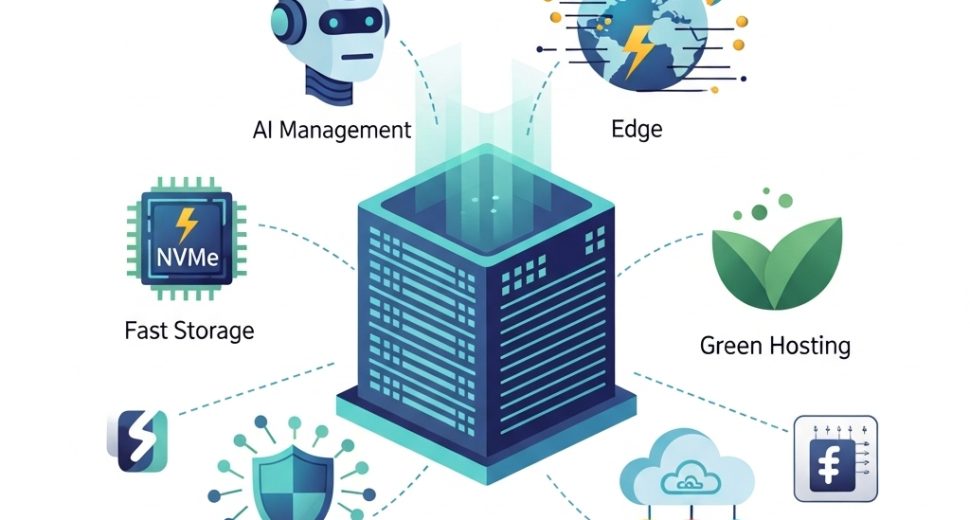

The web hosting industry never stands still — and in 2026, it is evolving faster than ever. Understanding the latest web hosting trends in 2026 is no longer just useful for developers and IT teams. Business owners, marketers, and entrepreneurs who understand where hosting technology is heading are better positioned to make infrastructure decisions that give their websites a measurable competitive advantage. From artificial intelligence and edge computing to sustainability mandates and NVMe storage, the shifts happening right now are reshaping what great hosting looks like — and what it costs.
In this guide, we cover every major web hosting trend in 2026 that deserves your attention — what is driving each shift, what it means in practical terms, and how to position your website to benefit from it.
Why Staying Ahead of Hosting Trends Matters for Your Business
Your hosting environment directly affects your website’s speed, uptime, security, and SEO performance. Consequently, hosting decisions made today based on outdated assumptions can leave you on ageing infrastructure while competitors migrate to environments that load faster, scale more efficiently, and cost less to operate.
Furthermore, many of the trends reshaping the hosting industry in 2026 are not incremental improvements — they represent fundamental changes in how servers are built, managed, and priced. Therefore, understanding them now gives you the ability to ask better questions when evaluating providers, negotiate more informed contracts, and upgrade at the right moment rather than being forced into reactive decisions by performance problems.
As explored throughout our web hosting guides, the best hosting decisions combine an understanding of your current needs with an awareness of where technology is heading. This article gives you the forward-looking half of that equation.
Trend 1 — AI-Powered Hosting Management is Becoming Standard
Artificial intelligence is no longer a future concept in web hosting — it is actively being deployed across the industry right now. AI-powered hosting management refers to the use of machine learning algorithms to monitor server performance, predict resource demands, detect security threats, and optimise configurations automatically — without human intervention.
What AI Hosting Management Does in Practice
Leading hosting providers are integrating AI systems that continuously analyse server metrics — CPU usage, memory consumption, traffic patterns, response times — and make real-time adjustments to maintain optimal performance. Consequently, servers running AI management tools deliver more consistent performance with fewer manual interventions than traditionally managed infrastructure.
Additionally, AI-driven predictive scaling anticipates traffic spikes before they occur — based on historical patterns, scheduled events, and external signals — and pre-allocates resources accordingly. This is a significant improvement over reactive scaling, which responds to demand after performance has already degraded.
Furthermore, AI is transforming hosting security. Machine learning models trained on billions of attack patterns identify novel threats in real time, blocking malicious traffic before it reaches applications. This capability is explored further in our article on website security features every hosting plan should have.
What This Means for You
When evaluating hosting providers in 2026, ask specifically about AI-assisted management capabilities. Providers investing in these tools deliver better uptime, faster response times, and stronger security than those relying purely on traditional monitoring and manual intervention. Moreover, as AI management tools mature, their performance advantages over conventional approaches will only widen.
Trend 2 — Edge Computing is Pushing Hosting Closer to Your Visitors
Edge computing is one of the most consequential infrastructure shifts in the hosting industry. Traditionally, websites are served from centralised data centres — meaning visitors far from the server experience higher latency. Edge computing addresses this by processing requests and serving content from servers positioned geographically close to the end user — at the “edge” of the network.
How Edge Hosting Works
Rather than every request travelling to a central data centre, edge hosting distributes lightweight server nodes across dozens or hundreds of locations globally. Static content — and increasingly, dynamic content and application logic — is processed locally, dramatically reducing the distance data must travel.
For context, a visitor in Karachi loading a website hosted on a server in Amsterdam experiences approximately 120–150ms of network latency from geography alone. However, with edge hosting, that same request might be served from a node in Dubai or Mumbai — reducing latency to under 20ms.
Why Edge Computing Matters for SEO and User Experience
As covered in our guide on how hosting speed affects SEO rankings and user experience, page load speed directly influences Google rankings through Core Web Vitals. Edge hosting dramatically improves Largest Contentful Paint (LCP) and Time to First Byte (TTFB) scores for global audiences — the two metrics most directly affected by server-to-visitor distance.
Consequently, businesses with international audiences or growth ambitions beyond their home market should prioritise hosting providers investing in edge infrastructure. In 2026, edge hosting is transitioning from a premium enterprise feature to a mainstream offering — and the performance gap between edge-hosted and traditionally hosted sites is becoming increasingly visible in search rankings.
Trend 3 — NVMe Storage is Replacing Standard SSDs
Storage technology is advancing rapidly, and NVMe (Non-Volatile Memory Express) is emerging as the new performance standard in hosting infrastructure — replacing the SATA SSDs that themselves replaced traditional spinning hard drives just a few years ago.
NVMe vs SATA SSD vs HDD — The Performance Difference
The performance gap between storage types is significant and measurable:
| Storage Type | Read Speed | Write Speed |
|---|---|---|
| HDD | ~150 MB/s | ~120 MB/s |
| SATA SSD | ~550 MB/s | ~500 MB/s |
| NVMe SSD | ~3,500 MB/s | ~3,000 MB/s |
NVMe storage communicates directly with the CPU via the PCIe interface rather than through the slower SATA controller — eliminating a bottleneck that limited even the best SATA SSDs. Furthermore, NVMe drives deliver dramatically lower latency in addition to raw speed — meaning server response times on NVMe infrastructure are measurably faster than equivalent SATA SSD setups.
What NVMe Hosting Means for Your Website
Websites hosted on NVMe storage experience faster database queries, quicker file reads, and lower TTFB scores. For WordPress sites, e-commerce platforms, and any application that queries a database on page load, the improvement is particularly pronounced.
Additionally, as NVMe hardware costs continue declining, the premium over standard SSD hosting is shrinking. In 2026, NVMe storage is becoming the default offering on quality VPS and cloud hosting plans — making it a specification worth checking explicitly when comparing providers.
Trend 4 — Green Hosting is Transitioning From Nice-to-Have to Expected
Environmental sustainability has moved from the periphery of the hosting industry to its centre. Green web hosting — powered by renewable energy, carbon-offset operations, and energy-efficient infrastructure — is one of the fastest-growing segments of the market in 2026.
Why Sustainability Matters in Hosting
Data centres consume enormous amounts of electricity. According to the International Energy Agency, global data centres consumed approximately 200–250 TWh of electricity annually in recent years — a figure that continues growing with cloud adoption. Consequently, the hosting industry’s carbon footprint is substantial and under increasing regulatory and public scrutiny.
In 2026, the pressure for sustainable hosting comes from multiple directions simultaneously:
- Regulatory requirements — the EU and other jurisdictions are introducing carbon reporting requirements that affect businesses using energy-intensive cloud services
- Consumer expectations — a growing percentage of consumers actively prefer businesses that demonstrate environmental responsibility
- Corporate sustainability commitments — large enterprises increasingly require suppliers — including hosting providers — to demonstrate credible sustainability credentials
Green Hosting in Practice
Genuine green hosting goes beyond purchasing carbon offsets. Leading providers are investing in:
- On-site renewable energy generation — solar and wind power at data centre locations
- Power Purchase Agreements (PPAs) — long-term contracts for renewable energy sourced from the grid
- Energy-efficient hardware — modern server architectures that deliver more compute per watt
- Liquid cooling systems — more energy-efficient than traditional air cooling at scale
- Waste heat recovery — repurposing server heat for building heating in colder climates
For businesses building sustainability into their brand identity, choosing a green hosting provider is increasingly both an ethical and a marketing decision.
Trend 5 — Managed Hosting Demand is Accelerating
The managed hosting segment is growing faster than the overall hosting market — driven by increasing technical complexity, rising security threats, and the growing recognition that server administration is not a core competency for most businesses.
As explored in our detailed guide on managed vs unmanaged hosting, managed hosting transfers server-level responsibilities — updates, security, monitoring, backups — to the provider, freeing business owners to focus on their actual work.
Why Managed Hosting is Growing
Several converging factors are driving managed hosting growth in 2026:
Security complexity — the threat landscape has grown sophisticated enough that maintaining adequate server security now requires specialist knowledge that most businesses do not have in-house. Managed providers with dedicated security teams offer a level of protection that self-managed servers rarely achieve.
Time cost awareness — as businesses mature, the true cost of self-managing servers — in developer time diverted from product work — becomes increasingly apparent and difficult to justify.
Compliance requirements — GDPR, HIPAA, PCI DSS, and equivalent regulations are driving demand for managed environments where compliance is maintained continuously and documented by the provider.
Remote team growth — distributed teams benefit from managed hosting because it removes single-point dependencies on specific team members with server knowledge.
Consequently, the distinction between managed and unmanaged hosting is increasingly driving provider selection decisions — particularly among growing businesses that have moved beyond shared hosting onto VPS and cloud infrastructure.
Trend 6 — Serverless Hosting is Gaining Mainstream Adoption
Serverless hosting — sometimes called Function-as-a-Service (FaaS) — is a model where developers deploy individual functions or application components rather than managing entire server environments. The hosting provider handles all infrastructure management, scaling, and availability automatically.
How Serverless Differs From Traditional Hosting
In traditional hosting, you provision a server — or a portion of one — and pay for it whether your application is receiving traffic or sitting idle. In serverless hosting, functions execute only when triggered and you pay exclusively for the compute time consumed during execution.
Furthermore, serverless scales instantaneously — from zero requests to millions — without any configuration. There are no servers to size, no capacity planning decisions, and no idle resource costs during quiet periods.
Who Benefits From Serverless in 2026
Serverless hosting is particularly compelling for:
- API-driven applications with unpredictable request volumes
- Event-driven workflows that run intermittently rather than continuously
- Microservices architectures where individual components scale independently
- Development teams that want to ship faster without operational overhead
However, serverless is not appropriate for every workload. Long-running processes, stateful applications, and websites built on traditional CMS platforms like WordPress are better served by conventional VPS or cloud hosting. Therefore, serverless represents an additional option in the hosting toolkit rather than a replacement for established approaches.
Trend 7 — Cybersecurity is Becoming a Core Hosting Feature
The line between hosting and cybersecurity is blurring rapidly in 2026. Historically, security was largely the website owner’s responsibility — the hosting provider supplied the server and the customer secured the application. That model is changing fundamentally.
Security-First Hosting Architecture
Leading providers are building security deeply into their infrastructure — not as an optional add-on but as a core architectural component. This includes:
- Built-in Web Application Firewalls active on every plan by default
- Zero-trust network architecture — treating every connection as potentially hostile until verified
- Automated vulnerability scanning that identifies and patches weaknesses before they are exploited
- AI-driven threat detection that identifies novel attack patterns in real time
- Immutable infrastructure — servers that are regularly rebuilt from clean images rather than patched in place, eliminating accumulated vulnerabilities
Additionally, the regulatory environment is driving security investment. Data protection regulations now carry significant financial penalties for breaches attributable to inadequate security practices — creating direct financial incentives for hosting providers to invest in robust security infrastructure.
As detailed in our guide on website security features every hosting plan should have, the security baseline for quality hosting has risen substantially — and providers that cannot meet it are losing customers to those that can.
Trend 8 — Multi-Cloud and Hybrid Hosting Strategies are Normalising
Multi-cloud hosting — distributing workloads across multiple cloud providers simultaneously — and hybrid hosting — combining cloud infrastructure with dedicated or on-premise servers — are rapidly moving from enterprise-only strategies to mainstream approaches for mid-market businesses.
Why Businesses are Adopting Multi-Cloud
Vendor lock-in risk is the primary driver. Businesses that concentrate all infrastructure on a single cloud provider are exposed to that provider’s outages, pricing changes, and policy decisions. A multi-cloud strategy distributes risk across providers while allowing workloads to be placed on the most cost-effective or performance-appropriate platform for each use case.
Furthermore, regulatory requirements in certain markets mandate that specific data types be stored in specific geographic regions — sometimes on separate infrastructure from other workloads. Multi-cloud and hybrid strategies make these compliance requirements achievable without sacrificing operational flexibility.
As explored in our comparison of cloud hosting vs traditional hosting, the choice between hosting models is increasingly not binary — businesses are combining approaches based on the specific requirements of different workloads.
Trend 9 — Hosting Control Panels are Being Modernised
The hosting control panel — the browser-based interface through which customers manage their accounts — is undergoing significant modernisation. cPanel, which has dominated the market for over two decades, faces growing competition from alternatives including Plesk, DirectAdmin, CyberPanel, and cloud-native dashboards built by providers themselves.
What Modern Control Panels Offer
New-generation control panels prioritise:
- Cleaner, more intuitive interfaces that reduce the technical knowledge required for common tasks
- One-click staging environments for testing changes before pushing to production
- Integrated performance monitoring with real-time server metrics visible to users
- Built-in Git integration for developer workflows
- API access for automated management of hosting resources
- Mobile-responsive design for managing hosting accounts from any device
Additionally, the rise of cloud-native hosting has driven providers to build proprietary management interfaces specifically designed for their infrastructure — offering tighter integration than generic panels can achieve.
Trend 10 — Hosting Pricing Models are Evolving
The traditional fixed monthly subscription model — pay a set price for a set allocation of resources — is being challenged by more flexible pricing approaches that better reflect actual usage.
Emerging Pricing Models in 2026
Consumption-based pricing — pioneered by major cloud providers — charges based on actual resource usage rather than provisioned capacity. This model delivers cost efficiency for variable workloads but requires careful monitoring to avoid bill surprises.
Burstable plans — a hybrid approach where a base allocation is provisioned at a fixed price, with additional resources available on demand at a per-use rate. This model combines the predictability of fixed pricing with the flexibility of consumption-based billing.
Credits-based systems — some providers are moving toward credit allocations that can be used flexibly across different services — hosting, storage, bandwidth, email — within a single account. Consequently, businesses can redistribute their hosting budget dynamically without purchasing separate plans for each service.
Understanding these pricing model differences is increasingly important when comparing providers. Our guide on how to choose the right hosting provider covers pricing transparency as a key evaluation factor — relevant regardless of which pricing model a provider uses.
Frequently Asked Questions
What is the biggest web hosting trend in 2026?
AI-powered hosting management and edge computing are arguably the two most consequential trends in 2026 — directly improving performance, security, and reliability in ways that are immediately measurable in speed tests and uptime metrics.
Is NVMe hosting worth the premium over standard SSD hosting?
For most business websites and e-commerce stores, yes. The performance improvement in database query times and file read speeds is measurable and directly affects Core Web Vitals scores. As NVMe costs decline, the price premium over SATA SSD hosting is shrinking rapidly.
Should my business switch to a green hosting provider?
If sustainability is part of your brand values — or if your clients operate in industries with carbon reporting requirements — switching to a verified green hosting provider is a worthwhile decision. Furthermore, green providers are increasingly investing in the most modern, energy-efficient hardware — meaning environmental responsibility and performance are not in conflict.
What is serverless hosting and should I use it?
Serverless hosting executes application functions on demand without provisioned servers. It is excellent for API workloads, event-driven applications, and microservices. However, it is not currently appropriate for WordPress sites, traditional CMS platforms, or applications requiring persistent server-side state.
How does edge computing benefit my website’s SEO?
Edge computing reduces physical distance between your server and your visitors — directly lowering TTFB and improving LCP scores. Both metrics are Core Web Vitals factors that Google uses as ranking signals. Consequently, edge hosting delivers measurable SEO benefits for websites with geographically diverse audiences.
Final Thoughts: The Web Hosting Trends in 2026 That Deserve Your Attention
The web hosting trends in 2026 covered in this guide represent a fundamental evolution in what hosting infrastructure looks like — not incremental improvements to the status quo. Staying informed about these developments puts you in a position to make better infrastructure decisions, ask better questions of your providers, and upgrade at the right moment rather than being left behind.
To recap the ten key trends:
- AI-powered management — smarter, faster, more proactive hosting operations
- Edge computing — servers positioned closer to visitors for lower latency
- NVMe storage — dramatically faster than SATA SSDs, becoming the new standard
- Green hosting — sustainability moving from optional to expected
- Managed hosting growth — server administration shifting to specialist providers
- Serverless hosting — function-level deployment without infrastructure management
- Security as infrastructure — cybersecurity built into hosting architecture by default
- Multi-cloud strategies — distributing workloads across providers for resilience
- Modern control panels — more intuitive, more integrated management interfaces
- Evolving pricing models — consumption-based and burstable plans gaining ground
As a result, the businesses best positioned for online growth in 2026 and beyond are those that treat hosting as a strategic infrastructure decision — not just a commodity purchase. For domain registration, web hosting, VPS, cloud hosting, and business email solutions built around the trends shaping the industry right now, Abhax is ready to help your business build on infrastructure that performs.